Pest dossier · Insects
Red imported fire ants
A yard suspect with a sting. Identify the mound and understand the Texas two-step.
Last updated October 3, 2026
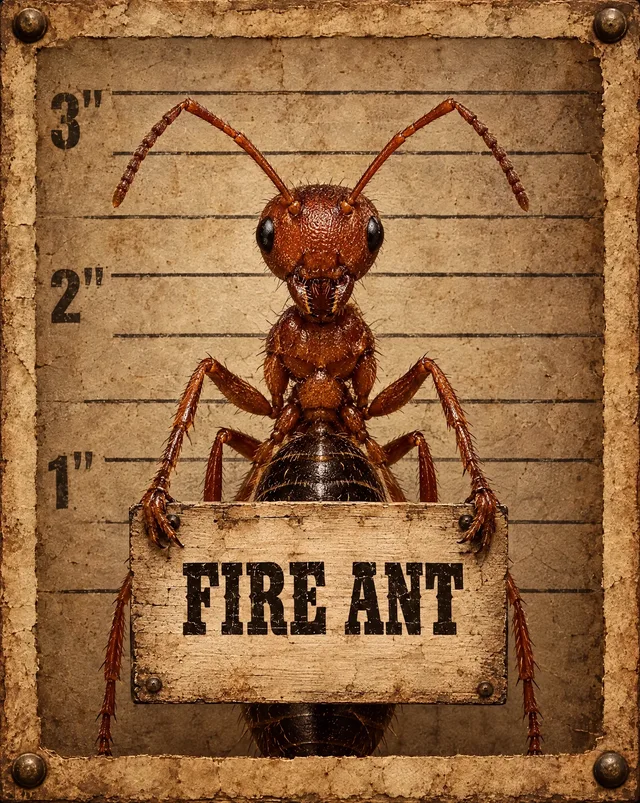
Fire ant control starts with identification and a plan for the whole affected yard. Keep people away from active mounds while deciding whether baiting and targeted mound treatment are warranted.
Know the suspect
Workers are reddish to dark brown, about 1/16 to 3/16 inch long, and vary in size. Fire ant mounds often lack a visible entrance hole on top. They usually nest outdoors in soil, but may enter DFW homes for food or water, including during floods or hot, dry conditions. Do not disturb a mound to test the identification. Texas A&M ant identification Extension household ant guide
The wanted portrait is a stylized AI illustration, not an identification photograph. Compare the actual animal and its markings with an Extension identification guide.
What they can do
Fire ants bite to hold on and then sting; disturbing a colony can expose someone to multiple stings. Reactions vary and allergic reactions can be serious. A skin mark alone does not identify the insect or diagnose the reaction. Texas A&M guidance
Start with control, not a spray
- Observe suspected mounds from a distance; keep children and pets away.
- Check yard work and play areas before mowing, gardening or setting equipment down.
- Wear closed shoes for yard work and avoid stepping on active mounds.
- Repair accessible entry gaps around doors and plumbing.
- Secure food waste and repair water leaks that attract foraging ants indoors.
These steps reduce exposure and indoor resources; they do not eliminate a soil colony. Confirm the species before treating a yard. Texas A&M guidance
Chemicals you may encounter
The Texas two-step method combines broadcast fire ant bait with targeted treatment of problem mounds. Extension names hydramethylnon, indoxacarb and spinosad in bait examples, and methoprene or pyriproxifen in growth-regulator baits. These are examples, not interchangeable products or a promise of immediate control. Baits depend on active foraging; rain and watering can interfere. Never use gasoline or improvised poison mixtures. Extension Texas two-step method
The label is the law. Use a product labeled for the actual pest and location, and follow its directions for placement, amounts, protective equipment and re-entry. Keep products and treated areas away from children and pets as the label directs. Never use an outdoor-only pesticide indoors or assume more product works better. EPA pesticide safety
Seasonal watch
Use North Texas warm-weather yard inspections and changes after rain as prompts to check mounds and foraging. A visible winter mound does not mean ants are actively collecting bait. Use activity and the label, not a fixed month, to guide decisions. Texas A&M guidance
When to get help
A qualified, licensed pest professional is warranted for recurring indoor fire ants or mounds where sting avoidance is difficult. Seek emergency medical care for breathing difficulty or a serious whole-body reaction after a sting. Discuss known sting allergy with a doctor. Extension sting-reaction guidance Texas A&M guidance
This field guide is educational and does not offer treatment bookings.
Common questions
What is the Texas two-step method?
It combines broadcast fire ant bait with targeted treatment of problem mounds.
Does bait work immediately?
Baits depend on active foraging and are not a promise of immediate control. Rain and watering can interfere.
Should I disturb a mound to identify it?
No. Observe from a distance and keep children and pets away from suspected active mounds.
Field notes on this suspect
- Field notes · SeasonalA weather-dependent, season-by-season guide to the pests North Texas homeowners commonly see, with what to watch and what to do.
- Field notes · Control basicsTexas A&M's Two-Step Method pairs yard-wide fire ant baiting with targeted mound treatments. Here is how and when it works.