Pest dossier · Insects
Paper wasps and red wasps
An eave-nesting suspect. Observe the nest from a distance and reduce sting exposure.
Last updated October 3, 2026
Paper wasp control starts with locating the nest and deciding whether it poses a contact risk. Leave remote nests alone when practical, and avoid disturbing an occupied nest near a doorway or porch.
Know the suspect
Paper wasps are about 3/4 to 1 inch long, often reddish orange to dark brown with possible yellow markings. "Red wasp" is a common description, not enough to confirm a species. Their open, umbrella-like paper comb hangs from a narrow attachment, unlike an enclosed yellowjacket nest. Check DFW eaves, porches, sheds and garages from a distance; queens may also shelter in attics and enter through gaps. Texas A&M wasp identification guide
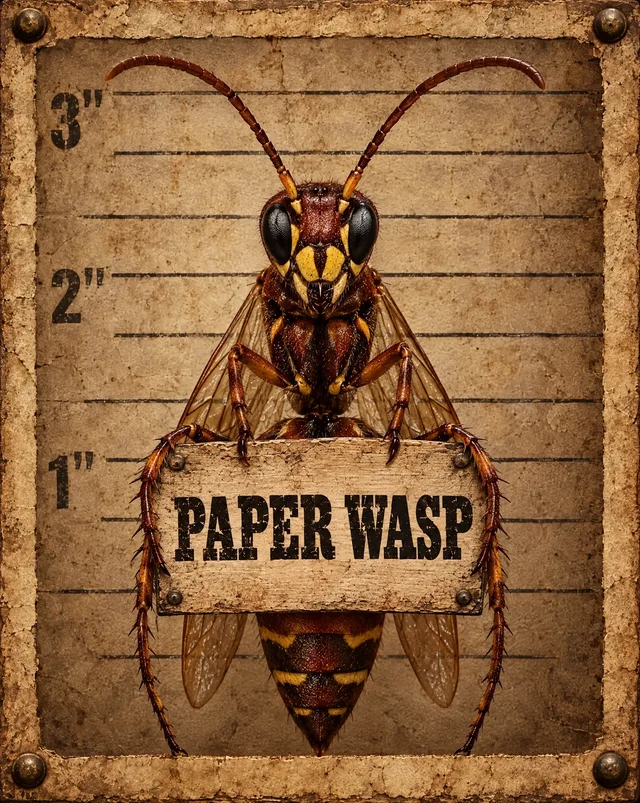
The wanted portrait is a stylized AI illustration, not an identification photograph. Compare the actual animal and its markings with an Extension identification guide.
What they can do
Paper wasps defend occupied nests and can sting repeatedly. Most stings cause local pain, but serious allergic reactions are possible. They also prey on other insects, so a wasp away from people is not automatically a treatment target. Extension wasp overview Extension sting guidance
Start with control, not a spray
- Inspect eaves and porch corners visually without touching a nest.
- Keep children, pets and routine foot traffic away from occupied nests.
- Avoid swatting at wasps or shaking the support holding a nest.
- Repair screens and suitable gaps after confirming no active nest is enclosed.
- Keep garage and shed doors closed when not in use.
An empty-looking comb is not proof that it is safe to handle. Assess activity from a distance, and leave high or occupied nest removal to someone equipped for it. Texas A&M guidance
Chemicals you may encounter
Extension names pyrethrins, tetramethrin and permethrin among active ingredients in wasp-control products. These are examples, not instructions to spray from a ladder or treat every nest. Product reach does not establish safe access, and the formulation must be labeled for the nest and location. Extension chemical overview
The label is the law. Use a product labeled for the actual pest and location, and follow its directions for placement, amounts, protective equipment and re-entry. Keep products and treated areas away from children and pets as the label directs. Never use an outdoor-only pesticide indoors or assume more product works better. EPA pesticide safety
Seasonal watch
Use North Texas spring porch and eave checks to watch for new nest construction. Colonies begin in spring and develop through summer; queens may enter sheltered buildings during warmer winter spells. These are inspection prompts, not dates that make a nest safe. Texas A&M guidance
When to get help
A qualified, licensed pest professional is warranted for nests at busy entrances, high nests or uncertain identification. Anyone with known sting allergy should avoid nest work. Seek emergency medical care for breathing difficulty or a serious whole-body reaction after a sting. Texas A&M guidance
This field guide is educational and does not offer treatment bookings.
Common questions
How does a paper wasp nest look?
Its open, umbrella-like paper comb hangs from a narrow attachment, unlike an enclosed yellowjacket nest.
Should every paper wasp be killed?
No. Wasps prey on other insects, and remote nests can be left alone when practical.
When should I check the eaves?
Use spring checks to watch for new nest construction, and remain alert through summer and warmer winter spells.